
RISC vs CISC Explained Simply: Why Modern Microcontrollers Use RISC| 为什么现代单片机都喜欢 RISC?
Over the past few years, I’ve worked with microcontrollers — MSP430, STM32, ESP32, and of course many versions of Arduino boards. And something interesting clicked recently:
Almost all of these chips are based on RISC, the Reduced Instruction Set Computer architecture.
At first glance, the word “reduced” sounds like a downgrade.
Why would engineers intentionally choose a processor that does less?
But the story is actually the opposite — it’s about doing less, faster, cleaner, and using much less power.
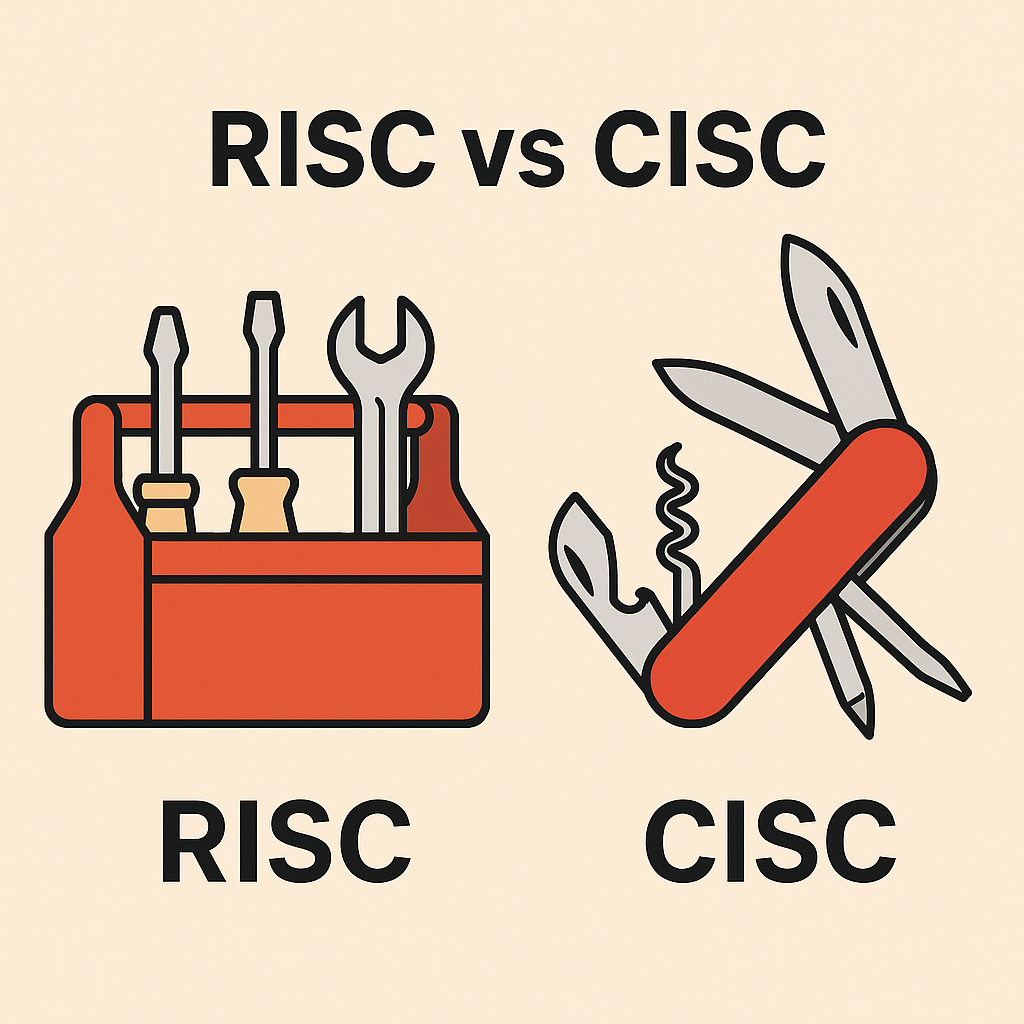
The “Toolbox” Analogy
Think of a toolbox:
- RISC is like having a few essential tools, each simple and efficient.
- CISC is like having a giant multi-tool Swiss Army knife that can do everything, but is slower and bulkier.
With RISC:
- Every operation is simple.
- The chip stays cool.
- Timing is predictable.
- Battery life is much longer.
In embedded systems — especially those running off coin cells, small Li-ion packs, or solar — simplicity wins.
Where We See RISC Today
| Device | Typical MCU | Architecture |
|---|---|---|
| Arduino Uno / Nano | ATmega328P | RISC |
| MSP430 LaunchPad | MSP430 Core | RISC |
| STM32 Boards | ARM Cortex-M | RISC |
| ESP32 (most models) | Xtensa / RISC-V | RISC |
The only major place where CISC still dominates is in PC/laptop processors (Intel & AMD).
Even then — fun fact — they internally translate CISC instructions into RISC-like micro-operations.
The whole world has quietly shifted to RISC.
Cortex vs Xtensa — Why Two Different RISC Families?
When you work with STM32 and ESP32, you quickly notice they behave differently.
| Feature | ARM Cortex-M (STM32) | Xtensa (ESP32) |
|---|---|---|
| Personality | The “well-trained soldier” | The “clever and flexible scout” |
| Strengths | Standardized, stable, consistent | Customizable, optimized for WiFi/Bluetooth |
| Best For | Industrial controls, aerospace, robotics | IoT, wireless, smart devices |
| Ecosystem | Very mature and extensive | Smaller, but very enthusiastic community |
In short:
- STM32 is what you learn if you want to understand professional embedded systems.
- ESP32 is what you reach for if you need WiFi, Bluetooth, and power efficiency in one tiny board.
And the fun part?
Newer ESP32 chips (like ESP32-C3 / C6) are now using RISC-V, an open-source instruction set that is expanding very quickly.
So the embedded world is still evolving — exciting times to learn!
So Which Should You Learn First?
If you want to go deeper into embedded engineering:
→ Start with STM32 (ARM Cortex-M)
If you want to prototype IoT projects quickly:
→ Start with ESP32
If you’re just getting started from zero:
→ Arduino or MSP430 is still perfectly fine.
There is no “one best chip”.
There is only the chip that fits the purpose.
Final Thought
Embedded systems is a journey where you gradually learn to choose the right tool, not the fanciest one.
Sometimes the most elegant solution is also the simplest.
And that’s why RISC continues to win.
为什么现代单片机都喜欢 RISC?一场“工具箱哲学”的故事
最近在整理我自己的嵌入式学习笔记,突然发现一个有意思的现象:
我们平时常用的那些单片机 — MSP430、STM32、ESP32、Arduino — 清一色几乎都是 RISC 架构。
为什么不选听起来更“豪华”的 CISC?
难道不是功能越多越好吗?
其实答案很简单:
越简单,越好用;越小巧,越省电。
工具箱哲学
先想象一下你的工具箱:
RISC:精简工具箱
只有螺丝刀、钳子、扳手。
每个工具都 简单、直接、用完就收,速度快。
CISC:瑞士军刀
一个工具上带十几种功能,看起来强大,
但真正使用的时候——
要翻半天,还不顺手,还费力。
在嵌入式世界里,设备经常要 靠电池长时间运行。
所以省电 + 简单 + 可靠 的 RISC 就成了主角。
现实中的选择
| 设备 | 使用的核心 | 架构 |
|---|---|---|
| Arduino Uno / Nano | AVR | RISC |
| MSP430 | MSP430 Core | RISC |
| STM32 | ARM Cortex-M | RISC |
| ESP32 | Xtensa / RISC-V | RISC |
而 PC 的 Intel/AMD 属于 CISC,
但内部也会偷偷转换成 RISC 风格执行。
所以说,世界早就站在 RISC 这边了。
Cortex vs Xtensa:两种 RISC,不同风味
| 特点 | Cortex-M(STM32) | Xtensa(ESP32) |
|---|---|---|
| 性格 | 训练有素、规规矩矩 | 灵活聪明、能自己长功能 |
| 优势 | 工业标准、生态大 | 可定制、无线通信表现强 |
| 常见场景 | 工控、仪器、机器人 | IoT、智能家居、可穿戴 |
一句话:
STM32 是正规军,ESP32 是特种兵。
更好玩的是——
新一代 ESP32 已经转向 RISC-V。
未来嵌入式一定会接触到它。
那应该从哪里学起?
| 学习目标 | 推荐单片机 | 理由 |
|---|---|---|
| 想做“真正的嵌入式工程” | STM32 | 行业标准 |
| 想做 IoT / 无线通讯项目 | ESP32 | 自带 WiFi + 蓝牙 |
| 完全新手 | Arduino / MSP430 | 简单、好上手 |
选对,不选多。
最适合的,才是最好的。
最后一句话
嵌入式不是堆砌功能,
而是追求 优雅、稳定、省电、可靠。
而这,就是 RISC 的魅力。
